 ·
3 minute read
·
3 minute read
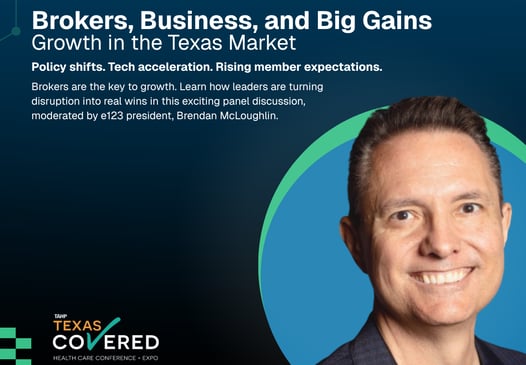
At this year’s Texas Association of Health Plans (TAHP) conference, I had the opportunity to moderate a panel discussion titled “Brokers, Business, and Big Gains: How Texas Health Plans Can Drive Profitable Growth in a Rapidly Changing World.”
I was joined by industry leaders Cristin Hopkin-Bishop, Chief Operating Officer at The Brokerage Inc.; Kari Klass, SVP of Sales at Harbor Health, and Elizabeth Lopez-Cepero, a healthcare expert. Our conversation focused on how shifting regulations, market ambiguity, and member churn are reshaping the way plans work with brokers and agents. We also discussed how strengthening these relationships can create meaningful competitive advantage, with each panelist bringing valuable insight from the field.
Across the entire discussion, several takeaways stood out. These are the insights that matter most for plans right now.
Ambiguity Is the New Normal. Clarity Is Currency.
Cristin opened the session with an important point. The 2025 enrollment season started with unusual uncertainty. ACA shopping windows were delayed. Medicaid unwinding continues to push a large number of Texans into new coverage options. Subsidy changes remain a real possibility. In a state where nearly one in five residents remains uninsured, these factors matter.
Cristin said something that stayed with me: “In ambiguity, clarity is currency.”
Agents and FMOs want consistent guidance from carriers, with even resources like provisional timelines and early interpretations helping. The field could not have been clearer– when plans communicate early and often, they build trust and loyalty. Plans that show up with clarity will win more than attention. They will win commitment.
Retention Is the Real Growth Strategy
Another major theme was the importance of retention. Growth doesn’t only come from new enrollments, but also from the members and agents who stay.
Cristin said, “When you focus on retention, opportunities come up.”
When agents have the information and support they need, they deliver better member experiences. That leads to lower disenrollment, stronger persistence, and an increase in organic referrals.
Liz reinforced this idea. Just because a product doesn’t sell today doesn’t mean that it won’t sell in the future. A strong, positive agent experience ensures that the relationship stays healthy for the next opportunity.
Commissions Are a Lever, Not the Whole Machine
Kari, who is in the process of launching Harbor Health, discussed how she uses commissions to motivate agents and encourage them to learn about new products. She said, “Commissions are a powerful lever to maneuver members to the right plan and attract agents to learn more about your products.”
At the same time, the panel agreed that agents are not simply motivated by payouts. The best producers think long term. They work across lines of business, serve entire households, and value stability and partnership.
I shared my view as well. The real margin is found in retention, not just acquisition. When plans use incentives to reinforce persistency and member outcomes, and when they combine incentives with data transparency and strong post-sales support, agents become true partners in delivering a great member experience.
Agents Want Data, Not Downloads
One of the most consistent requests from the field is increased visibility.
Cristin noted that many carriers still hold back basic information such as enrollment status and commission progress. Kari added that when an agent is contracted with eight carriers, it becomes very difficult to understand where they stand without a central, reliable view.
Agents and FMOs don’t want static spreadsheets that are confusing and often error-prone. They want real-time dashboards that provide:
- Application status and commission updates
- Early warnings for at-risk members, including pharmacy disruptions or provider changes
- Geo mapping and engagement data that help guide outreach
- Clear book-of-business views for renewals and terminations
Liz summarized the message well. “Agents are trusted advisors. Creating mutual respect through data transparency is critical.”
Plans that make data usable strengthen trust. They also create alignment between plans, FMOs, and frontline agents.
Data-Driven Partnerships Are the Future of Health Insurance Distribution
Liz raised another important challenge. While it’s simple to share data with one agency, it becomes much more difficult to do it consistently across dozens of partners, multiple products, and a variety of markets. That requires technology that can scale.
This is one of the reasons that we built Abacus, e123’s solution for Agents. Brokers. Commissions. Health plans need a secure and compliant way to share data, manage commissions, and unify contracting and performance visibility. These capabilities enable better coaching, stronger retention plays, and a more predictable growth strategy.
“Sales data does not let you measure outcomes and effectiveness. Seeing engagement data is where the real insights live,” stressed Liz. Engagement data reveals which agents are learning, logging in, and educating themselves on your products. It also helps plans understand which partners are most likely to drive quality growth.
The Takeaway: Growth Comes from Connection
The panel reinforced what I see daily at e123: health plans that achieve sustainable and profitable growth do three things exceptionally well.
- They prioritize transparency by communicating early and clearly, even when final answers are not available.
- They reward and support retention, not just initial acquisition.
- They share data in ways that build trust and enable smarter action.
Agents are not an extension of a sales funnel. They are an extension of your brand. When your systems, incentives, and data strategies reflect that, growth becomes the natural outcome.
The outcomes we all want, from better retention and stronger agent relationships to fewer operational blind spots, depend on having the right infrastructure in place. Abacus gives health plans that foundation. Learn more and request a demo here.